Signs of Hidden Underground Pipe Leaks in Shah Alam Homes: Technical Diagnostic Guide
Comprehensive engineering guide to identifying concealed slab leaks, Air Selangor water bill surges, clay soil settlement fractures, and non-destructive acoustic tracing in Shah Alam landed properties.
Emergency Engineering Guide: Shah Alam Reticulation
A sudden spike in your monthly Air Selangor bill, wet concrete patches on your front driveway, or the persistent nocturnal hissing sound behind bathroom tiles often indicates a concealed underground pipe rupture. Across Shah Alam’s residential communities—from mature landed terraces in Seksyen 1 to Seksyen 25 and Taman Sri Muda to newer master developments in Setia Alam, Bukit Jelutong, and Kota Kemuning—hidden underground leaks represent one of the most destructive and financially draining plumbing emergencies a property owner can face.
Left undetected, a high-pressure underground water leak does far more than inflate your monthly utility invoice; it progressively erodes the sub-slab soil bedding beneath your car porch, creates subterranean sinkhole voids, weakens foundation footings, and forces moisture up into load-bearing brick walls via capillary action.
In this comprehensive technical diagnostic guide, our experienced local plumbing specialists break down the geological, municipal, and metallurgical causes of hidden slab leaks in Shah Alam, explain how to perform a definitive isolation test on your water meter, and detail professional non-destructive remediation strategies.
1. Why Shah Alam Properties Suffer from Hidden Underground Pipe Leaks
Concealed pipe failures in Shah Alam are rarely random accidents. Rather, they are the direct consequence of three interacting local engineering realities:
A. Alluvial Clay Soil Settlement and Ground Shear Forces
A substantial portion of Shah Alam—particularly low-lying zones adjacent to the Klang River basin such as Taman Sri Muda, Seksyen 18, Seksyen 24, and parts of Kota Kemuning—is constructed on deep alluvial silty clay deposits. Unlike stable granite bedrock, unconsolidated clay expands significantly when saturated during heavy monsoon downpours and shrinks during dry spells.
Over decades, this continuous ground expansion and contraction induces differential foundation settlement. When a rigid underground supply pipe is embedded beneath a reinforced concrete car porch slab or living room floor, ground settlement exerts massive shearing stress across pipe elbows and threaded joints. Eventually, the pipe snaps or develops stress-fatigue hairline fissures beneath the slab.
B. Aging Galvanized Iron (GI) Plumbing in 1970s–1990s Housing Stock
In mature Shah Alam housing developments constructed between 1975 and 1998 (including Seksyen 2 through Seksyen 20), residential potable water systems were routinely installed using unlined Galvanized Iron (GI) pipework cast directly into the concrete floor slab.
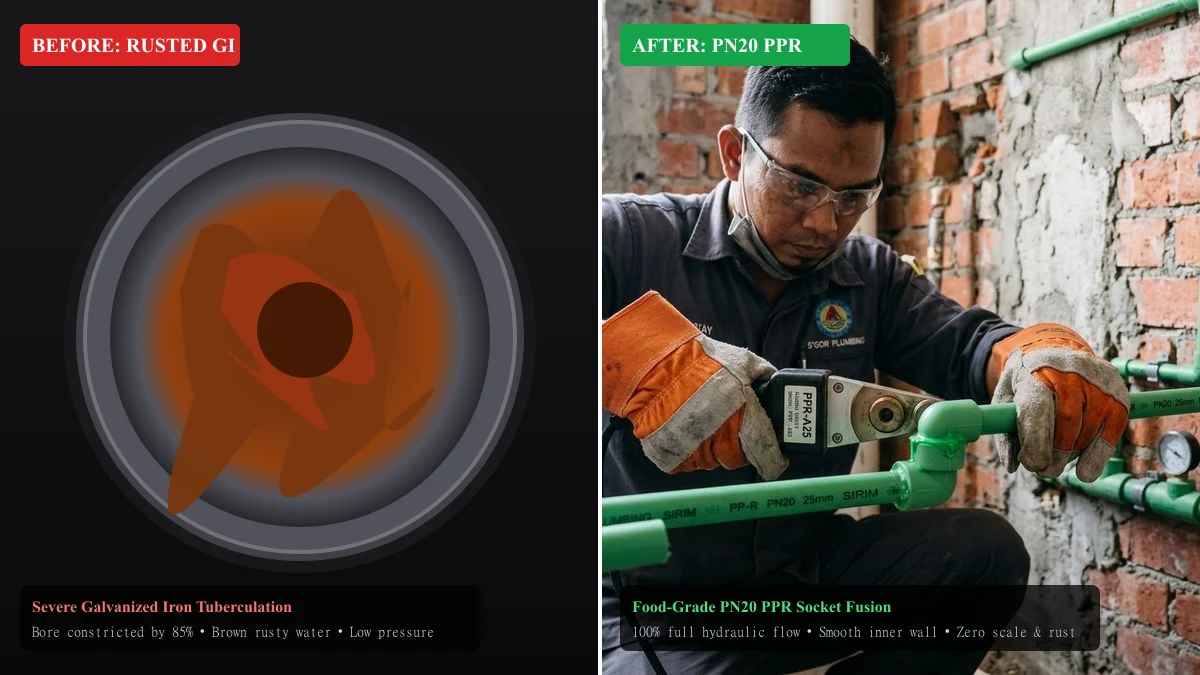
While galvanization protects steel against atmospheric oxidation, internal contact with treated municipal water causes progressive electrochemical corrosion over 20 to 30 years. Minerals and dissolved oxygen react with the iron, forming internal rust tubercles (tuberculation) that constrict water flow while thinning the pipe wall from the inside out. Once the wall thickness is compromised, high municipal water pressure causes pinhole ruptures that weep pressurized water continuously into the slab bedding.
C. Air Selangor Nocturnal Mains Pressure Surges
Shah Alam’s water distribution grid receives pressurized supply from the Sungai Selangor Water Treatment Plants (SSP Phase 1, Phase 2, and Phase 3) as well as the Rantau Panjang plant. To overcome long transit distances, Air Selangor operates trunk distribution mains at substantial pressures.
During off-peak nocturnal hours (between 1:00 AM and 5:00 AM), domestic water draw across the Klang Valley drops to its daily minimum. Consequently, line pressure along major Shah Alam distribution corridors—including Persiaran Kayangan in Seksyen 7, Persiaran Mokhtar Dahari connecting Denai Alam, and Persiaran Jubli Perak in Seksyen 20—surges to 5.0 to 6.5 bar (72 to 94 PSI). Without a calibrated brass Pressure Reducing Valve (PRV) installed downstream of the water meter, these nocturnal pressure surges subject aging pipe joints to hydraulic shock, blowing out solvent-welded Class D PVC elbows and fatigued copper solder joints.
2. The 5 Cardinal Warning Signs of a Concealed Pipe Rupture
1. Unexplained Surges in Monthly Air Selangor Invoices
The earliest and most reliable warning sign of an underground pipe leak is financial. If your household occupants and daily water usage patterns have remained unchanged, yet your monthly Air Selangor bill escalates from a typical RM 35–RM 50 baseline to RM 120, RM 280, or higher, a continuous leak is active downstream of your meter.
Because Air Selangor employs a progressive tiered tariff structure for domestic consumers in Selangor, high water volume pushes consumption into the highest pricing bracket (exceeding 35 cubic meters per month), resulting in exponential billing spikes.
2. Sinking Car Porch Pavers, Driveway Cracks, and Wet Grout
Because underground main pipes typically run beneath the front driveway or car porch apron connecting the street boundary meter to the internal riser, underground bursts frequently discharge beneath the paving. Observable outdoor indicators include:
- Interlocking driveway pavers sinking or becoming uneven due to subsoil washout.
- Constant dampness or green moss growth along driveway paving joints during prolonged hot, dry weather.
- Silt, fine sand, or air bubbles emerging from expansion joints between the car porch slab and perimeter drain walls.
- Hollow echoing sounds when tapping driveway concrete with a metal rod, indicating that escaping water has excavated an underground void.
3. Continuous Spinning of the Water Meter Flow Indicator
Every municipal water meter installed by Air Selangor features a small central flow indicator—usually a red star, triangular spindle, or rotating black cogwheel. This indicator is geared to detect low-flow rates down to 0.5 liters per hour. If this spindle spins continuously when all taps inside the house are closed, water is leaking downstream of the meter stopcock.
4. Warm, Discolored, or Efflorescent Floor Tiles
When an underground leak occurs beneath indoor ground-floor living areas, pressurized water migrates upward through the concrete slab via capillary pores. Homeowners often notice:
- Individual ceramic floor tiles feeling noticeably warm underfoot (in the case of concealed hot water pipe leaks).
- Hollow-sounding or loose tiles where rising moisture has debonded the tile adhesive or cement screed.
- White crystalline salt deposits (efflorescence) coating tile grout lines or the lower 12 inches of plastered brick walls.
- Blistering paint, peeling wallpaper, and darkened timber skirting boards along hallway walls.
5. Persistent Hissing Sounds in Quiet Nighttime Hours
Pressurized water escaping through an underground pinhole or hairline fracture emits a characteristic high-frequency acoustic hiss (typically between 800 Hz and 2,200 Hz). In a quiet house late at night when ambient traffic noise on the Federal Highway or LKSA has subsided, this sound can be heard vibrating through ground-floor bathroom walls, under-sink cupboards, or directly through the car porch floor.
Comprehensive Diagnostic Matrix: Hidden Leak Symptoms vs Root Causes
The following reference matrix correlates observable symptoms with verified trade findings across Shah Alam neighborhoods:
| Observable Symptom | Probable Location & Failure Mechanism | Typical Shah Alam Townships | Structural Risk Level | Recommended Trade Remediation |
|---|---|---|---|---|
| Monthly water bill jumps by RM 80–RM 300+ | Underground incoming main rupture between meter and storage cistern | Seksyen 7, Seksyen 11, Setia Alam, Bukit Jelutong | High: Continuous water waste and sub-slab soil erosion | Calibrated pressure baseline testing, acoustic listening rod tracing, HDPE/PEX bypass |
| Meter red flow spinner rotates while taps are closed | Concealed sub-slab main break or defective toilet cistern flush siphon | Seksyen 13, Kota Kemuning, Taman Sri Muda | Severe: Active subterranean void formation | Main line zone isolation, hydrostatic pressure drop testing, surgical pipe repair |
| Efflorescence & bubbling paint 12” up wall | In-wall cold water riser joint shear or corroded GI pipe nipple | Seksyen 2, Seksyen 4, Seksyen 18, TTDI Jaya | High: Concrete spalling, plaster degradation, black mold | Precision diamond wall opening, replacement with PN20 PPR socket fusion weld |
| Sinking car porch interlocking pavers / wet joints | Pinhole rupture on buried PVC Class D or poly pipe under driveway | Alam Impian, Denai Alam, Seksyen 24, Glenmarie | Critical: Driveway apron collapse and foundation undermining | Trenchless bypass or surface-mounted perimeter PEX repiping in neat casing |
| Nocturnal hissing sound behind master bathroom tiles | Thermal stress fracture on concealed hot water supply line | Bukit Jelutong, Setia Eco Park, Seksyen 9 bungalows | Moderate: Ceiling staining, tile debonding, grout decay | Acoustic joint tracing, targeted tile access, replacement with high-temp PEX-AL-PEX |
| Attic ceiling damp patches below water tank | Overflow pipe failure or cracked internal poly tank bulkhead fitting | Seksyen 6, Seksyen 17, Taman Sri Muda landed terraces | Severe: Sudden ceiling plaster collapse and timber rot | Emergency ball valve overhaul, tank scour drainage, food-grade SUS304 tank upgrade |
3. Step-by-Step Homeowner Water Meter Isolation Protocol
Before contacting an emergency plumbing specialist, homeowners can definitively confirm whether an underground supply pipe leak exists by executing this 4-step diagnostic isolation test:
[Step 1: Indoor Fixture Lockdown]
  │  Shut every tap, basin mixer, bidet spray, washing machine inlet, and water filter.
  ▼
[Step 2: Roof Cistern Isolation]
  │  Tie up the attic storage tank ball valve float arm to prevent refill draw.
  ▼
[Step 3: Meter Indicator Verification]
  │  Inspect the Air Selangor boundary meter red triangular spinner for 10 minutes.
  ▼
[Step 4: Hydrostatic Isolation Analysis]
  └── If spinning continues: Underground leak confirmed between boundary meter and cistern.
  └── If spinner is stationary: Main incoming line is intact; leak is internal fixture or gravity feed.
Step 1: Complete Indoor Fixture Lockdown
Close all water draw points inside the building:
- Ensure all kitchen sink and bathroom taps are firmly turned off.
- Disconnect or close isolation valves on external garden hoses, washing machines, and refrigerator ice makers.
- Turn off the dedicated inlet stopcock supplying outdoor multi-stage water filters.
Step 2: Isolate the Roof Storage Cistern
In standard Malaysian double-storey landed homes, the incoming municipal supply line runs directly up to an attic storage cistern. If the ball valve inside this cistern is slowly trickling, the water meter will spin even though no pipes are broken.
- Access the roof space or open the ceiling access manhole.
- Gently tie up the float arm of the equilibrium ball valve using a string, or close the gate valve immediately preceding the tank inlet.
- This isolates the entire overhead storage system, ensuring zero water enters the cistern.
Step 3: Inspect the Boundary Meter Spinner
- Walk to your property boundary water meter located at the front gate or perimeter fence.
- Clean dirt from the glass display and locate the central flow indicator (the small red triangular dial or rotating cogwheel).
- Observe the indicator continuously for 5 to 10 minutes.
Step 4: Interpret the Diagnostic Result
- If the spinner remains completely stationary: Your main incoming supply line between the municipal meter and the roof storage cistern is fully intact. Any unexplained dampness is likely caused by an internal gravity-fed pipe, a leaking bathroom floor trap, or rain ingress.
- If the spinner continues rotating: You have a confirmed pressurized supply leak on the incoming line. Water is continuously escaping into the ground or wall structure under active municipal line pressure.
4. Professional Trade Diagnostics: How Plumbers Locate Underground Leaks
Traditional, outdated plumbing methods involved “blind demolition”—smashing open driveways or bathroom tiles based on guesswork until a wet patch was uncovered. Modern trade craftsmanship rejects this destructive approach. Qualified plumbers employ a systematic 3-stage non-destructive diagnostic methodology:
Stage 1: Calibrated Hydrostatic Pressure Baseline Testing
Our technicians connect a liquid-filled Bourdon tube test gauge (rated 0–16 bar) to an accessible test point, such as an outdoor bib tap or washing machine angle valve. We record the incoming municipal static pressure, then close the Air Selangor boundary stopcock to isolate the private reticulation. By observing pressure drop over a 15-minute test window, we establish the exact volumetric rate of line leakage (measured in bar drop per minute).
Stage 2: Sectional Valve Isolation
Large landed properties often feature secondary branch valves controlling garden lines, ground-floor utility sinks, and upper-floor risers. By systematically opening and closing branch valves while monitoring test gauge pressure, we narrow the failure down to an isolated 3-to-5-meter pipe segment.
Stage 3: Mechanical Acoustic Listening Rod Tracing
Pressurized water discharging through an underground crack forces its way through surrounding compacted gravel and sand, generating distinctive structural acoustic vibrations.
Technicians place heavy-duty brass and solid steel acoustic listening rods directly in contact with exposed pipe fittings, stopcocks, meter risers, and structural floor slabs along the pipeline route. The solid acoustic probe mechanically amplifies high-frequency hiss, allowing the plumber to track the sound gradient. The volume peaks sharply directly above the rupture coordinates. Once confirmed, diamond cutting blades make a neat, localized opening strictly limited to the repair footprint, preserving surrounding floor tiles.
5. Modern Repair Strategies: Repairing vs Whole-House Repiping
When a hidden pipe leak is verified beneath a concrete slab, homeowners face a critical choice between a localized patch repair and a permanent surface repiping upgrade:
                    ┌──────────────────────────────────────────────┐
                    │  Concealed Underground Pipe Leak Detected    │
                    └──────────────────────┬───────────────────────┘
                                           │
                    ┌──────────────────────┴───────────────────────┐
                    ▼                                             ▼
       [Local Spot Repair Option]                    [Surface Bypass Repiping]
       • Age of pipe: <10 years                     • Age of pipe: >20 years (Old GI)
       • Single isolated joint shift                • Recurrent leaks across property
       • PEX or modern HDPE material                • Corroded internal tuberculation
       • Diamond-cut 1-tile footprint               • Food-grade PPR PN20 in neat casing
       • Fast turnaround & cost-effective           • Permanent 50-year maintenance fix
When a Local Spot Repair Makes Sense
If your home was constructed within the last 10 to 15 years using modern HDPE poly or PEX piping, and the leak is caused by an isolated ground settlement shift at a single elbow, a localized spot repair is highly effective.
- Technicians make a clean diamond score around one or two tiles.
- The concrete is carefully opened to expose the fractured fitting.
- The damaged segment is cut away using square rotary pipe cutters.
- A new heavy-duty PN16 poly compression fitting or food-grade PN20 PPR socket fusion coupler is welded in place.
- The line undergoes an 8.0-bar hydrostatic pressure test before the opening is backfilled and re-tiled.
When Surface Bypass Repiping is the Only Sensible Long-Term Solution
If your landed home is located in Seksyen 2 to 25, Taman Sri Muda, or older parts of Shah Alam with original galvanized iron (GI) plumbing embedded in the foundation, repairing a single pinhole leak is almost always a temporary band-aid.
Because internal rust tuberculation has thinned the entire underground network, fixing one leak restores full line pressure, which promptly blows out the next weakest corroded elbow just a few feet away within months.
In these circumstances, experienced plumbers strongly advise Surface Bypass Repiping:
- The failing underground sub-slab GI line is permanently decommissioned and capped at the meter.
- A new, continuous drinking water supply line is routed above ground, running along external perimeter wall parapets, through the roof ceiling space, or inside clean white uPVC surface trunking along interior baseboards.
- We utilize food-grade PN20 Polypropylene Random Copolymer (PPR) connected via 260°C socket fusion heat-welding. PPR contains zero metallic components, is 100% immune to rust and scaling, handles high temperatures up to 95°C, and carries an anticipated lifespan exceeding 50 years.
- This approach requires zero floor demolition, eliminates the risk of future slab leaks, and can be completed across a typical double-storey home within 1 to 2 working days.
6. Air Selangor Water Bill Rebate Application: Plumber Documentation Protocol
When a concealed underground leak results in an astronomical water bill (frequently exceeding RM 200 to RM 500), homeowners in Selangor are entitled to submit an official application for an Excessive Water Bill Rebate (Pelarasan Bil Air Akibat Paip Bocor Tersembunyi) to Pengurusan Air Selangor Sdn Bhd.
To successfully qualify for billing adjustment, Air Selangor strictly requires verifiable documentation establishing that:
- The leak occurred on private concealed plumbing downstream of the municipal meter stopcock.
- The leak was not caused by negligence (such as leaving garden taps open or an overflowing swimming pool).
- The defect has been permanently repaired by an experienced trade plumbing contractor.
Required Documentation Checklist:
- Written Plumber Repair Statement: A signed technical invoice detailing the date of repair, the exact physical location of the sub-slab burst (e.g., “buried 20mm poly pipe beneath car porch apron”), and the parts replaced (e.g., “installation of PN16 brass compression coupling and pressure re-test at 8 bar”).
- Before-and-After Photographic Proof: Clear, dated on-site photographs showing the leaking pipe exposed in the ground with escaping water, followed by a second photograph showing the completed repair fitting before backfilling.
- Meter Reading at Repair Completion: The exact numerical meter index reading recorded immediately after the repair is finalized and pressure-tested.
Our service technicians prepare complete, compliant rebate documentation packages for customers upon completion of all underground pipe repairs in Shah Alam, maximizing the likelihood of a successful credit adjustment on your subsequent Air Selangor statement.
7. Preventive Measures: Safeguarding Your Home Against Future Leaks
To protect your property from recurrent underground plumbing emergencies:
- Install a Calibrated Pressure Reducing Valve (PRV): If your property is situated along high-pressure distribution trunks in Seksyen 7, Bukit Jelutong, or Denai Alam, install an adjustable brass PRV with a stainless steel pressure gauge immediately downstream of your water meter. Maintain incoming pressure between 2.5 and 3.0 bar to shield indoor pipes and mixer cartridges from nocturnal water hammer shocks.
- Perform Monthly Meter Checks: Establish a routine of checking your front water meter flow indicator on the first weekend of every month. Ten minutes of observation can save thousands of ringgit in utility bills and structural repairs.
- Inspect Perimeter Drain Outlets: Check your roadside perimeter drain outlets during dry weather. If clean, clear water is constantly trickling into the monsoon drain when no household taps are running, subsoil water from an underground leak may be draining out through retaining wall weep holes.
- Upgrade to Stainless Steel Storage: When replacing your roof storage cistern, upgrade to an approved food-grade SUS304 stainless steel tank with an engineered 3-valve booster pump bypass loop to ensure multi-day supply resilience during scheduled Sungai Selangor WTP maintenance shutdowns.
If you suspect a concealed pipe leak in your home or commercial premises, contact Plumber Shah Alam for prompt, transparent diagnostic tracing, upfront itemized quotations, and written 90-day workmanship warranties across all 27 Shah Alam townships.
Local Water Supply, MBSA Guidelines & Home Advice in Shah Alam
Understanding how Air Selangor water pressure and local council drainage rules work helps protect your home from sudden leaks and unnecessary repairs.
Managing Night-Time Water Pressure Spikes in Shah Alam
Along major transit corridors like Shah Alam service corridors, municipal supply lines deliver water at pressures averaging typical municipal water pressure. Late at night, when overall community tap usage drops, line pressure naturally surges. If indoor flexible hoses or water heater relief valves are aging, sudden spikes can cause fractures. Installing a calibrated Pressure Reducing Valve (PRV) stabilizes incoming pressure safely.
- Municipal water pressure surges significantly late at night when tap usage drops
- A calibrated brass pressure reducing valve protects internal pipes and appliances
- Prevents flexible hoses under bathroom sinks and toilets from sudden bursting
Why PN20 Green PPR & Poly Outlast Old Pipes in Shah Alam
Where ground movement in Shah Alam stresses buried fittings, our technicians utilize certified green PN20 PPR socket fusion pipes and tough HDPE poly coils. Socket fusion welds pipe and fitting into a single seamless piece of material at 260°C, creating a joint that absorbs ground settling without snapping or leaking.
- PPR PN20 socket fusion creates a single continuous pipe with zero glued joints
- Rated for 20 bar pressure, comfortably handling Shah Alam municipal surges
- Food-grade SIRIM-certified material keeps drinking water pure and odorless
Simple Preventive Plumbing Checks for Shah Alam Homes
A few easy checks every few weeks help keep your water flowing smoothly, protect your tapware, and prevent surprise plumbing emergencies.
Monthly Water Meter Spin Check
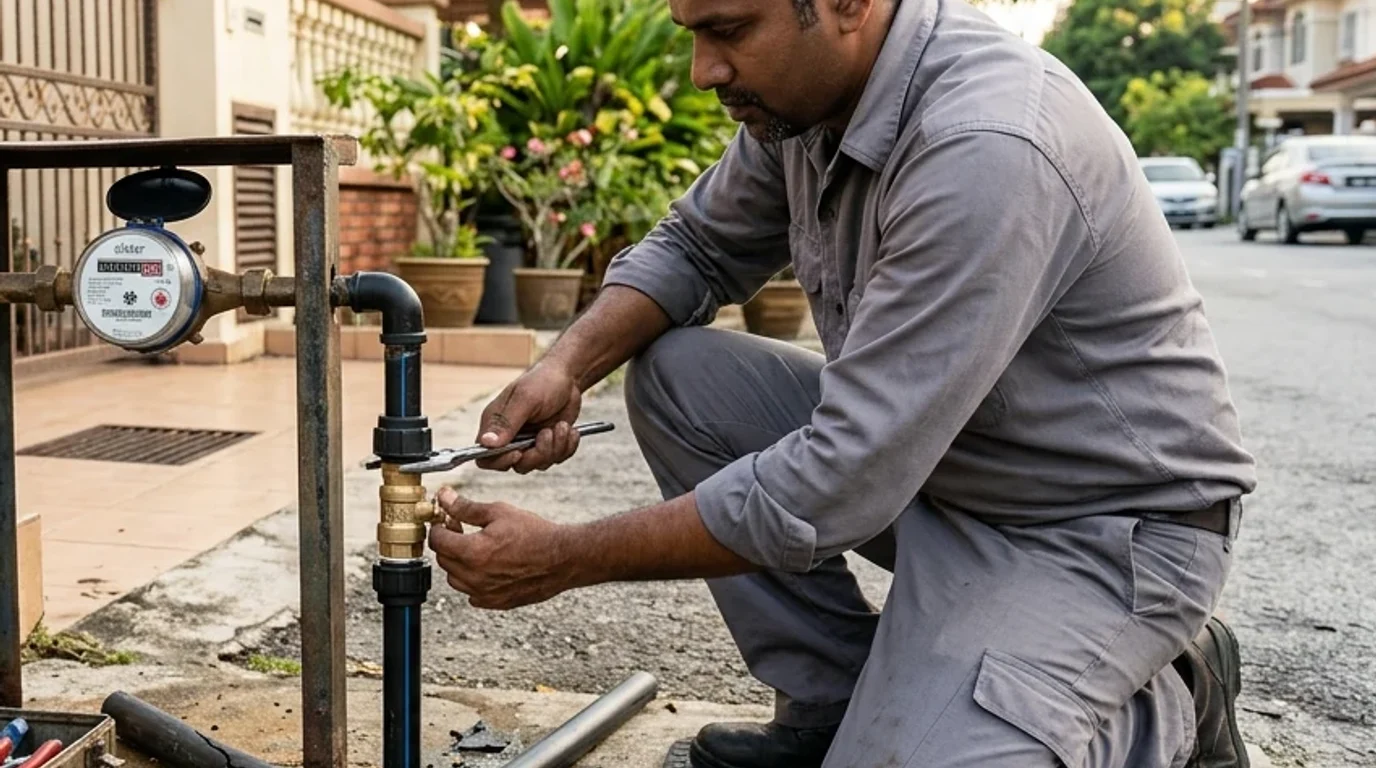
Turn off all taps, showers, and washing machines inside your Shah Alam home. Walk out to your front water meter and look at the small red star or arrow. If it is still creeping or spinning, water is escaping somewhere in your pipes—call our local plumber to check it before your bill spikes.
Inspect Flexible Braided Hoses Under Sinks
Look at the flexible braided hoses supplying your wash basins and water heaters in Shah Alam. Under municipal water pressures averaging local municipal water pressure, aging hoses can develop tiny wire fractures or rubber bulges that should be replaced before they burst.
Watch for Sudden Tap Pressure Drops
In Shah Alam, where normal water pressure runs around local municipal water pressure, a sudden drop in water pressure at all taps often means Air Selangor is doing pipe work in your neighborhood, or an internal line requires attention.
Facing This Plumbing Issue in Shah Alam?
Our Seksyen 7 mobile dispatch team is available 24/7. Get an upfront quotation via WhatsApp with zero obligation and 90-day warranty protection.