Monsoon Sewer Backup: The Emergency Drain Unclogging Checklist for Shah Alam Homeowners
Comprehensive emergency guide for Shah Alam homeowners on handling monsoon stormwater surcharges, sewer backups, grease fatbergs, and floor trap flooding.
Emergency Engineering Guide: Shah Alam Reticulation
During torrential inter-monsoon convective thunderstorms across Selangor, municipal drainage networks in Shah Alam frequently operate under severe hydraulic surcharge. For landed properties situated within low-lying river basins and flood-prone corridors—notably Taman Sri Muda (Seksyen 25), TTDI Jaya (Seksyen U2), Batu Tiga, Padang Jawa, and parts of Seksyen 13—the confluence of localized cloudbursts, high tidal curves in the downstream Klang River, and overfilled stormwater retention reservoirs creates acute backpressure on domestic drainage reticulation.
When municipal culverts fill beyond their hydraulic carrying capacity, wastewater cannot freely gravity-discharge away from domestic compounds. Instead, stormwater and raw sanitary sewage get forced backward through private perimeter gullies, kitchen floor traps, ground-floor shower wastes, and squatting toilet pans. Understanding how your domestic sanitary and stormwater systems interact with the Majlis Bandaraya Shah Alam (MBSA) municipal network—and executing a disciplined, step-by-step emergency protocol—is the difference between minor patio water pooling and thousands of ringgit in ruined timber flooring, contaminated drywall, and severe microbial contamination.
1. The Hydrology of Shah Alam Drainage Surcharge
To diagnose why your drains back up during storms, it is essential to understand the underlying civil reticulation layout typical of Shah Alam residential townships constructed between 1980 and the present day.
       TYPICAL DOMESTIC DISCHARGE RETICULATION IN SHAH ALAM LANDED ESTATES

  +-------------------------------------------------------------------------+
  | Domestic Living Area                                                    |
  |  [Kitchen Sink]    [Bathroom Shower]   [Ground WC Pan]                  |
  |         |                  |                  |                         |
  |         v                  v                  v                         |
  |    (P/S-Trap)         (Floor Trap)        (P-Trap)                      |
  |         |                  |                  |                         |
  +---------|------------------|------------------|-------------------------+
            | 50mm PVC         | 50mm PVC         | 100mm PVC
            v                  v                  v
  +-------------------------------------------------------------------------+
  | Private Underground Sanitary Branch Line (100mm Class D PVC)             |
  |                                                                         |
  |   ======> Direction of Normal Gravity Outflow ======>                  |
  +-------------------------------------------------------------------------+
                                    |
                                    v
                     +-----------------------------+
                     | Front Boundary Manhole /    |  <--- Critical Choke Point
                     | Inspection Chamber (IC 1)   |       (Root Ingress / FOG)
                     +-----------------------------+
                                    |
            +-----------------------+-----------------------+
            |                                               |
            v                                               v
  [MBSA Stormwater Drain]                        [IWK Sewer Reticulation]
  Perimeter open concrete trench                 Underground Vitrified Clay / HDPE
  (Roof runoff, patio wash, surface rain)         (Toilet foul soil, kitchen greywater)
  *Surcharges during monsoon cloudbursts*        *Surcharges when flooded by runoff*
The Separate System Mandate vs. Illicit Cross-Connections
Under Malaysian Uniform Building By-Laws (UBBL) and MBSA engineering guidelines, residential developments must maintain strictly separate systems for:
- Stormwater Drainage (Air Hujan): Open road-side monsoon drains, perimeter concrete perimeter aprons, and roof rainwater downpipes discharging directly into public street culverts and retention ponds.
- Sanitary Sewerage (Air Kumbahan): Underground vitrified clay pipes (VCP) or Class D unplasticized polyvinyl chloride (uPVC) carrying foul toilet waste and domestic greywater to municipal Indah Water Konsortium (IWK) sewer mains and regional sewage treatment plants.
However, during heavy tropical storms delivering rainfall intensities exceeding 90mm to 120mm per hour, two major issues trigger domestic backflow:
- Surface Inundation of Public Manholes: When street monsoon drains crest their banks, floodwater submerges the perforated cast-iron manhole covers of IWK sanitary mains. Hundreds of thousands of liters of rainwater enter the foul sewer system, exceeding its design capacity by 400% to 600%.
- Illegal Domestic Cross-Connections: In older renovated homes throughout Seksyen 17, Seksyen 18, Seksyen 20, and TTDI Jaya, backyard patio extensions frequently routed roof rainwater downpipes directly into domestic kitchen inspection gullies. During cloudbursts, this localized downpour volume overwhelms the home’s 100mm private sewer branch, forcing blackwater out through the lowest ground-floor fixtures.
2. Immediate Emergency Protocol: 5 Steps to Stop Drain Backflow
When gurgling sounds start bubbling up from your ground-floor toilet bowls or foamy water rises through bathroom floor traps during heavy rainfall, immediate action is essential to prevent sewage from ruining floor finishes, cabinets, and appliances.
+-------------------------------------------------------------------------------+
|                       5-STEP EMERGENCY MONSOON BACKFLOW PROTOCOL               |
+-------------------------------------------------------------------------------+
| Step 1: MECHANICAL SEALS   | Cap or weigh down ground-floor traps & toilet    |
| Step 2: ELECTRICAL SAFETY  | Trip ground-floor sub-circuits at distribution   |
| Step 3: SANITARY CEASE-FIRE| Prohibit all upper-floor tap and toilet usage    |
| Step 4: BOUNDARY CHECK     | Inspect front private inspection chamber         |
| Step 5: MOTORIZED CLEARING | Mobilize mechanical drum snake or hydro-jetter   |
+-------------------------------------------------------------------------------+
Step 1: Mechanically Seal Ground-Floor Drains Immediately
Do not wait for water to cover the bathroom tiles before acting:
- Floor Traps: Place a heavy rubber drain cover or folded heavy-gauge trash bag over the floor drain grating. Weigh it down firmly with a 15–20kg sandbag, a bucket filled with water, or large paver tiles. This creates counter-pressure against the hydraulic head pushing upward from the underground branch line.
- Toilet Bowls: Close the toilet seat lid and place heavy weights on top. If sewage is actively rising, insert a mechanical pneumatic test plug or inflatable drain bladder into the toilet throat and expand it with a hand pump to create a watertight seal.
Step 2: De-Energize Ground-Floor Electrical Circuits
Floodwater and sewer backflow carry dissolved salts and suspended solids, making them highly conductive. If water reaches skirting-level wall sockets or floor-mounted extension strips, severe electrocution and arc-fault fire hazards arise:
- Go immediately to your main electrical Distribution Board (DB).
- Switch off the Residual Current Device (RCD / ELCB) controlling the ground-floor 13A socket power sub-circuits.
- Leave upper-floor lighting circuits energized if the ceiling and distribution boards are dry.
Step 3: Enforce an Immediate Sanitary “Cease-Fire”
When your ground-floor drains are struggling with backpressure, the underground sewer pipe within your compound is full:
- Instruct all household members to cease running taps, washing machines, kitchen sinks, and upstairs showers.
- Do not flush upstairs toilets. Because upstairs fixtures sit higher up on the vertical soil stack, gravity will pull their discharge down to the ground level, where it will immediately erupt out of your ground-floor floor traps and kitchen gullies.
Step 4: Inspect Your Front Compound Boundary Chamber
Carefully lift the inspection chamber cover located inside your front gate or driveway apron using a pry bar or manhole lifting key:
- Observation A (Street Culvert Full, Chamber Full): If the road-side monsoon drain is completely brimmed and your front manhole is submerged under brown water, the municipal river/culvert system is backed up. Mechanical augering cannot clear this until street-level water recedes. Focus all efforts on interior drain plugs.
- Observation B (Street Culvert Flowing Freely, Chamber Submerged): If the public street drain is flowing normally below the kerb line, but your private boundary chamber is backing up with greasy grey sludge, your private 100mm lateral pipe has suffered an internal structural choke or grease fatberg.
- Observation C (Boundary Chamber Dry / Empty, House Traps Flooding): The blockage is situated within the sub-slab foundation pipe run between your ground-floor bathroom and the front driveway chamber.
Step 5: Mobilize Motorized Mechanical Augering or High-Pressure Hydro-Jetting
Once localized internal obstruction is identified, professional mechanical intervention is required. Hand plungers and store-bought chemical drain crystals are completely useless against severe underground structural blockages and fatbergs. Mobilize a professional drainage team equipped with continuous-cable drum machines or trailer-mounted hydro-jetting rigs.
3. Diagnostic Matrix: Identifying Blockage Source & Jurisdiction
Understanding who owns which section of the pipe network prevents costly disputes and delays during emergencies:
| Diagnostic Indicator | Probable Physical Cause | Legal Jurisdiction | Required Corrective Action |
|---|---|---|---|
| Single toilet gurgles; sinks drain normally | Foreign object lodged in ceramic P-trap or wax ring seal | Homeowner (Private fixture) | Heavy-duty kinetic toilet auger; replace wax pan collar |
| Kitchen gully overflows with thick white grease foam | Saponified Fat, Oil & Grease (FOG) calcification in 100mm horizontal run | Homeowner (Private branch line) | High-pressure rotary hydro-jetting with degreasing nozzle |
| All ground-floor floor traps bubble during washing machine spin | Undersized 50mm branch line or downstream main stack constriction | Homeowner (Private reticulation) | Mechanical drum snake descaling; install air admittance valve |
| Ground floor overflows while street drain is below kerb level | Boundary interceptor chamber choked with tree roots or collapsed vitrified clay | Homeowner (Private boundary) | Motorized spiral root-cutter head or boundary pipe relining |
| Brown river water rises from street drain into porch apron | Sungai Damansara / Sungai Rasau river crest exceeding culvert outfall invert | MBSA / JPS Selangor | Sandbag compound gate perimeter; install perimeter check valve |
| Sewage erupts through road manhole cover outside front gate | Municipal sewer main collapsed or trunk pumping station electrical failure | Indah Water Konsortium (IWK) | Lodge emergency report to IWK hotline; install private backflow valve |
4. Why Grease Solidification Is Shah Alam’s #1 Internal Drain Hazard
In residential neighborhoods across Shah Alam, commercial dining belts in Seksyen 7, Seksyen 9, and Seksyen 13, and family residential terraces in Seksyen 4, Seksyen 18, and Kota Kemuning, cooking habits heavily utilize palm cooking oil, santan (coconut milk), animal fats, and rich spice pastes.
                   THE ANATOMY OF A SUB-SLAB FATBERG CHOKE

   Warm Sink Wash Water + Liquid Cooking Oil + Dishwashing Detergent
                                |
                                v (Enters 50mm Under-Sink Waste)
   Cooling Zone Under Floor Slab (Underground Temperature 24°C - 26°C)
                                |
                                v (Oil solidifies into insoluble fatty acids)
   Reaction with Calcium Ions in Tap Water & Residual Concrete Leaching
                                |
                                v
   +---------------------------------------------------------------+
   | Hard Calcium Stearate Saponification ("White Concrete Fatberg") |
   | - Clings tenaciously to PVC pipe inner crown and invert        |
   | - Traps food particles, vegetable fiber, and hair              |
   | - Constricts 100mm pipe diameter down to 20mm or complete seal |
   +---------------------------------------------------------------+
When warm wash water cools as it travels underground through buried horizontal PVC runs, dissolved lipids solidify against the pipe crown and invert. Over months, these fatty acids react with alkaline minerals and calcium in domestic greywater, undergoing a chemical saponification reaction that forms hard, dense calcium stearate deposits commonly known as “fatbergs.”
These grease formations do not dissolve with hot tap water. When heavy monsoon storms hit and external water creates even slight hydrostatic resistance at the boundary manhole, the constricted 100mm pipe immediately stalls, precipitating an instant indoor flood.
5. The Danger of Caustic Chemical Drain Cleaners in Sub-Slab Plumbing
When faced with a stubborn drain backup, many homeowners instinctively pour multiple bottles of concentrated sodium hydroxide (caustic soda) or concentrated sulfuric acid down sinks and floor traps. In Malaysian landed properties, this practice frequently causes catastrophic structural plumbing damage:
+-------------------------------------------------------------------------------+
|         WHY CHEMICAL DRAIN CLEANERS CAUSE CATASTROPHIC PLUMBING FAILURES      |
+-------------------------------------------------------------------------------+
| 1. EXOTHERMIC HEAT DISTORTION: Sulfuric acid reacts with standing water,      |
|    generating temperatures exceeding 95°C. Thin-wall PVC pipes soften, sag,   |
|    and deform, permanently eliminating critical gravity fall gradients.       |
|                                                                               |
| 2. SOLVENT CEMENT MELTING: Caustic chemicals dissolve the methyl ethyl        |
|    ketone (MEK) bonding compounds in PVC solvent weld elbows, causing joints  |
|    to separate invisibly inside foundation slabs or ceiling plenums.          |
|                                                                               |
| 3. TOXIC FUME EMISSION: Acid interacting with stagnant organic grease emits   |
|    hazardous hydrogen sulfide (H2S) gas through open floor traps.             |
|                                                                               |
| 4. CALCIFIED PLUG COMPACTION: Caustic soda converts soft grease into solid    |
|    rock-hard soap blocks that cannot be penetrated by hand plungers.          |
+-------------------------------------------------------------------------------+
The Professional Mechanical Alternative
Instead of hazardous chemicals, certified plumbing tradecraft relies exclusively on two physical clearing methodologies:
- Motorized Heavy-Duty Cable Drum Augers: Utilizing 16mm or 22mm hardened spring-steel cables fitted with bulb heads, grease-cutting C-cutters, or articulating root-sawing blades. The rotating cable negotiates multiple 90-degree bends, boring through solid obstructions without applying chemical or thermal stress to PVC joints.
- High-Pressure Water Hydro-Jetting: Operating at regulated pressures between 1,800 PSI and 3,500 PSI, specialized reverse-thrust stainless steel nozzles blast concentrated water streams backward at a 45-degree angle. This simultaneously propels the hose forward along the pipe, scours grease and mineral scale completely off the 360-degree pipe circumference, and flushes dislodged slurry downstream into public manholes.
6. Long-Term Flood Defense: Installing a Sanitary Non-Return Backflow Valve
If your residence in Taman Sri Muda, TTDI Jaya, Setia Alam, or Bukit Jelutong has suffered drain backflow during regional storm surges, relying on temporary sandbags is an unsustainable strategy. Permanent engineering protection requires installing a heavy-duty sanitary non-return valve (NRV).
         CROSS-SECTION OF PRIVATE SANITARY NON-RETURN VALVE (NRV)

            Internal Inspection Chamber (Driveway / Side Compound)
   +-----------------------------------------------------------------------+
   |                                                                       |
   |   House Outflow (From Kitchen/WCs)             Towards Public Sewer   |
   |   ============================>                ====================>  |
   |                                                                       |
   |             +-----------------------+                                 |
   |             | Removable Clear Lid   |                                 |
   |             | (For Manual Rodding)  |                                 |
   |             +-----------+-----------+                                 |
   |                         |                                             |
   |                         v                                             |
   |             +-----------------------+                                 |
   |             | Weighted Stainless/   |                                 |
   |             | Neoprene Flapper Disc |                                 |
   |             |                       |                                 |
   |             |  \ (Normal Flow:      |                                 |
   |             |   \ Swings Open)      |                                 |
   |             |    v                  |                                 |
   |             |                       |                                 |
   |             |  | (Backflow Surge:   |                                 |
   |             |  | Slams Closed       |                                 |
   |             |  | Against O-Ring)    |                                 |
   |             +-----------------------+                                 |
   |                                                                       |
   +-----------------------------------------------------------------------+
How the Sanitary Non-Return Valve Works
- Forward Flow: During standard daily domestic water usage, gravity-driven wastewater pushes the lightweight, balanced flap disc forward on its brass or stainless steel hinge pin, allowing greywater and solids to pass unimpeded.
- Reverse Hydraulic Backflow: As soon as external stormwater or overloaded municipal sewer mains create positive backpressure pushing toward the house, the reverse fluid head forces the flapper disc firmly back against its elastomeric EPDM rubber seating rim.
- Positive Mechanical Barrier: The greater the external flood head, the tighter the flapper seals, completely barricading the domestic branch pipe from municipal sewage, street grit, and rodent intrusion.
Key Installation and Maintenance Specifications
- Placement: Must be installed inside the final private inspection chamber (IC) immediately before the boundary fence line, downstream of all domestic fixture connections.
- Fall Gradient: Must maintain a minimum fall of 1:60 to 1:80 across the valve body to prevent toilet paper and fecal solids from settling behind the flapper hinge.
- Quarterly Inspection: The chamber lid should be lifted every three months to verify that cooking fat or sanitary wipes have not adhered to the rubber sealing ring, ensuring smooth, unhindered flapper movement.
7. Homeowner Preventive Maintenance Schedule for Monsoon Season
Proactive mechanical maintenance carried out in September and October—prior to the peak northeast monsoon cloudbursts—eliminates over 90% of household drainage emergencies across Shah Alam:
| Frequency | Target Plumbing Component | Action Required | Tool / Method |
|---|---|---|---|
| Monthly | Kitchen Sink Traps & Floor Gullies | Inspect for sluggish vortex; remove hair and solid food remnants from secondary strainers | Manual basket cleaning; boiling water flush |
| Quarterly | Boundary Inspection Chambers | Pry open driveway manhole covers; inspect bottom half-round vitreous benching for grease scum or root entry | Visual torch inspection; nylon pull-brush |
| Bi-Annually | Under-Sink Grease Interceptors | Empty accumulated yellow grease cakes and bottom food sediment into sealed waste bags | Hand skimming; warm soapy washdown |
| Annually | Sub-Slab Lateral Sewer Lines | Perform preventive rotary drum snaking or rotary nozzle hydro-jetting to descale calcified grease | Professional mechanical drain auger |
| Pre-Monsoon | Perimeter Stormwater Apron Drains | Remove silt, garden soil, dead leaves, and moss from boundary open concrete channels | Flat-edge shovel and stiff bristle broom |
| Post-Storm | Sump Pump Pit & Float Switches | Test submersible basement sump pump by manually lifting float switch; clear pit debris | Manual float activation test |
8. Frequently Asked Questions Regarding Monsoon Drain Flooding in Shah Alam
Why do my ground-floor toilets gurgle only when it rains heavily?
When torrential rain enters municipal sewer lines or street runoff submerges the public manhole outside your home, trapped air inside the underground sewer pipe gets compressed by the rising water level. Because the air cannot escape through the waterlogged street mains, it is forced backward up your domestic soil stack, escaping by violently bubbling through the standing water seal inside your ground-floor toilet bowls. This is an early diagnostic sign that your sewer line is under severe hydraulic surcharge and may soon overflow.
Can tree roots crack underground drain pipes in residential compounds?
Yes. In mature residential areas like Seksyen 4, Seksyen 9, and Kota Kemuning, mature landscaping trees such as weeping figs, palms, and bougainvillea have vigorous root networks. Microscopic hair roots penetrate tiny fissures in old cement-jointed earthenware pipes or weathered PVC solvent weld collars seeking moisture. Once inside the nutrient-rich sewer stream, the roots expand into massive fibrous root balls that trap toilet paper and solids, causing complete blockages. These require motorized spiral root-cutter blades to sever and extract.
Does homeowners insurance cover water damage caused by sewer backups in Selangor?
Standard Malaysian fire and homeowner insurance policies typically cover sudden bursting of water tanks and domestic pipes, but almost universally exclude damage resulting from floodwaters, municipal drain surcharges, and sewer backups unless a specific “Flood Endorsement Extension” has been purchased. Inspect your policy schedule carefully and consult your insurer before monsoon season begins.
How quickly does domestic sewer backflow pose a health risk?
Raw sewer backflow is classified as Category 3 “Black Water” under international sanitization standards. It carries pathogenic microorganisms including Escherichia coli, Salmonella, and enteric viruses. Porous materials like carpets, particle-board kitchen base cabinets, and gypsum plasterboard that absorb sewer water cannot be completely sanitized and must generally be cut out and discarded to prevent hazardous black mold (Stachybotrys) growth.
Expert Emergency Drainage Assistance Across All Shah Alam Townships
If your home in Shah Alam is battling a stubborn underground drain blockage, bubbling toilet pans, or recurrent monsoon sewer backups, do not wait for wastewater to enter your living quarters. Our team provides reliable, transparent diagnostic and mechanical clearing services:
- Heavy-Duty Continuous Cable Augering: Safe, chemical-free descaling of sub-slab PVC runs without tile damage.
- High-Pressure Rotary Hydro-Jetting: Total elimination of saponified fatbergs and perimeter grease calcification.
- Sanitary Non-Return Valve Installation: Permanent mechanical engineering protection against municipal storm surges.
- Root-Sawing & Boundary Manhole Restorations: Complete repair of cracked vitreous benching and damaged junction collars.
Contact Plumber Shah Alam today for immediate consultation, upfront quotations, and long-lasting tradecraft solutions across all 56 Seksyens and surrounding townships.
Local Water Supply, MBSA Guidelines & Home Advice in Shah Alam
Understanding how Air Selangor water pressure and local council drainage rules work helps protect your home from sudden leaks and unnecessary repairs.
Managing Night-Time Water Pressure Spikes in Shah Alam
Along major transit corridors like Shah Alam service corridors, municipal supply lines deliver water at pressures averaging typical municipal water pressure. Late at night, when overall community tap usage drops, line pressure naturally surges. If indoor flexible hoses or water heater relief valves are aging, sudden spikes can cause fractures. Installing a calibrated Pressure Reducing Valve (PRV) stabilizes incoming pressure safely.
- Municipal water pressure surges significantly late at night when tap usage drops
- A calibrated brass pressure reducing valve protects internal pipes and appliances
- Prevents flexible hoses under bathroom sinks and toilets from sudden bursting
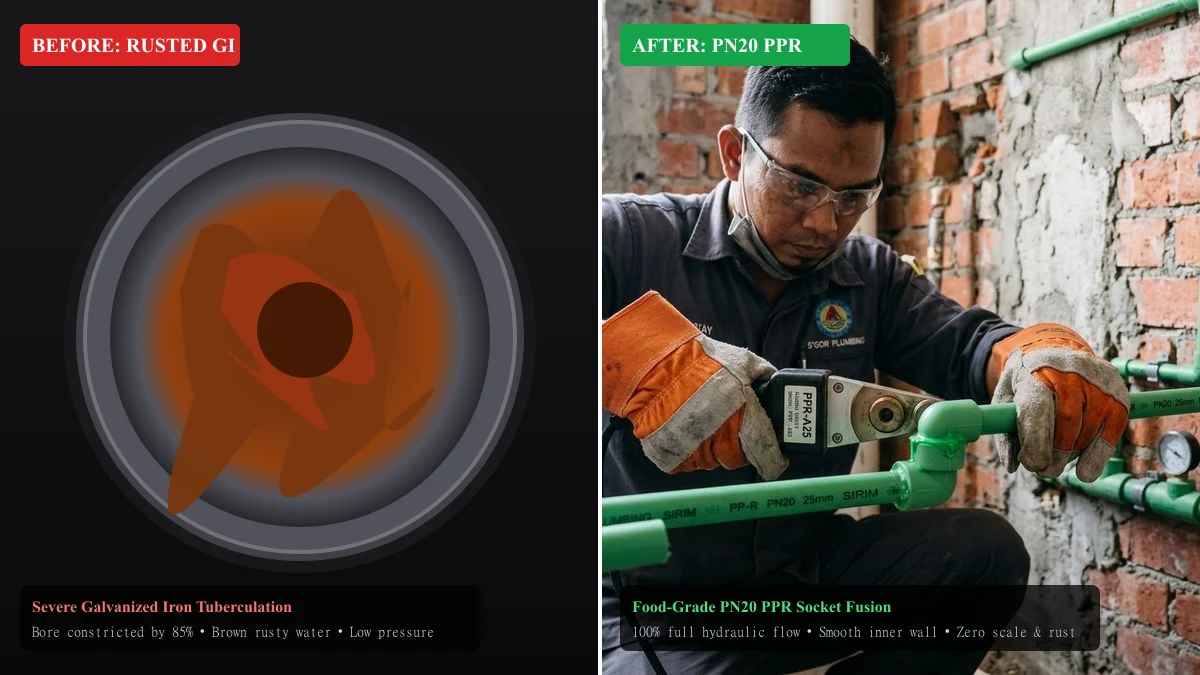
Why PN20 Green PPR & Poly Outlast Old Pipes in Shah Alam
Where ground movement in Shah Alam stresses buried fittings, our technicians utilize certified green PN20 PPR socket fusion pipes and tough HDPE poly coils. Socket fusion welds pipe and fitting into a single seamless piece of material at 260°C, creating a joint that absorbs ground settling without snapping or leaking.
- PPR PN20 socket fusion creates a single continuous pipe with zero glued joints
- Rated for 20 bar pressure, comfortably handling Shah Alam municipal surges
- Food-grade SIRIM-certified material keeps drinking water pure and odorless
Simple Preventive Plumbing Checks for Shah Alam Homes
A few easy checks every few weeks help keep your water flowing smoothly, protect your tapware, and prevent surprise plumbing emergencies.
Monthly Water Meter Spin Check
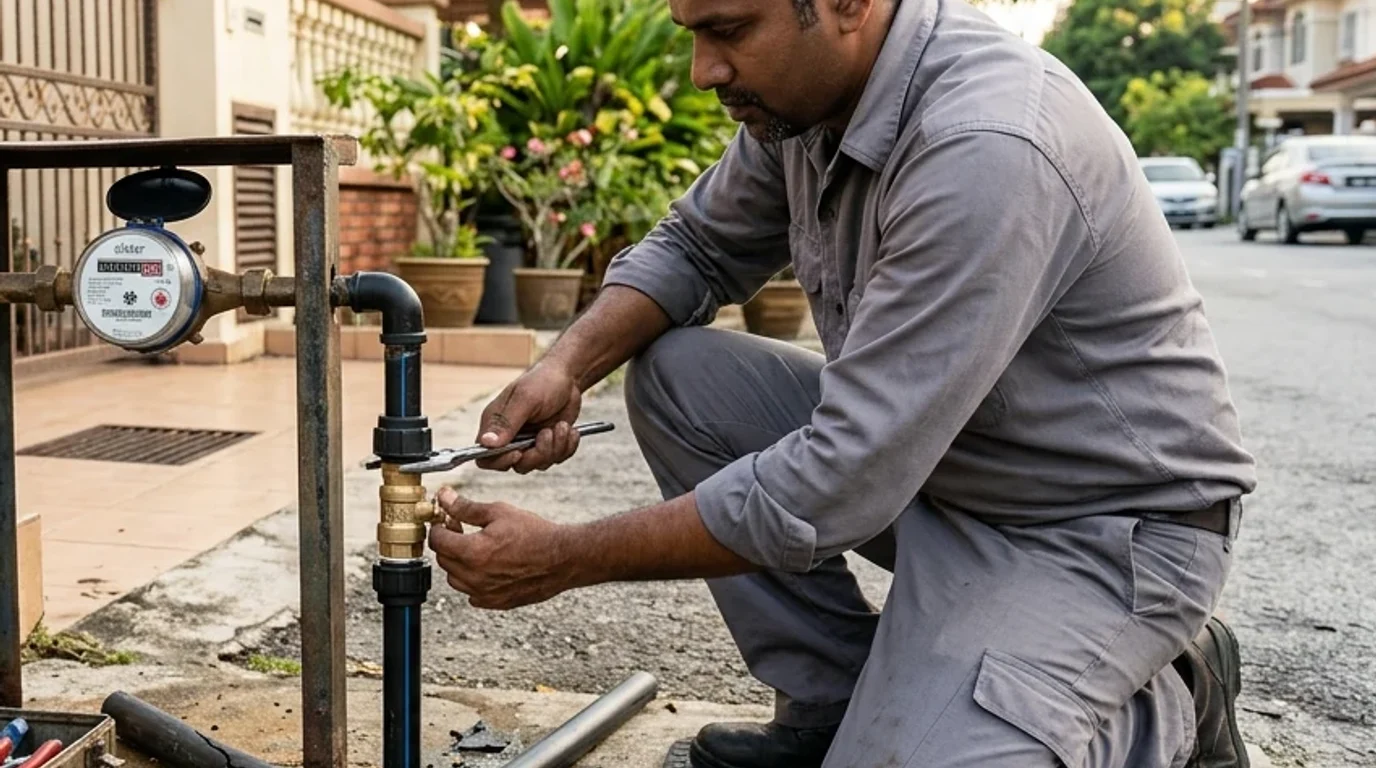
Turn off all taps, showers, and washing machines inside your Shah Alam home. Walk out to your front water meter and look at the small red star or arrow. If it is still creeping or spinning, water is escaping somewhere in your pipes—call our local plumber to check it before your bill spikes.
Inspect Flexible Braided Hoses Under Sinks
Look at the flexible braided hoses supplying your wash basins and water heaters in Shah Alam. Under municipal water pressures averaging local municipal water pressure, aging hoses can develop tiny wire fractures or rubber bulges that should be replaced before they burst.
Watch for Sudden Tap Pressure Drops
In Shah Alam, where normal water pressure runs around local municipal water pressure, a sudden drop in water pressure at all taps often means Air Selangor is doing pipe work in your neighborhood, or an internal line requires attention.
Facing This Plumbing Issue in Shah Alam?
Our Seksyen 7 mobile dispatch team is available 24/7. Get an upfront quotation via WhatsApp with zero obligation and 90-day warranty protection.